Wes-inspired art

From Les Herman:

Update: if you are interested in prints, please contact lesliepherman(at)gmail.com.

Wes Anderson

The Darjeeling Limited

From Phil:

“At the Movies” (starting in the front row, left to right: Terry Gilliam, Alfred Hitchcock, Stanley Kubrick, Wes Anderson, Jim Jarmusch, Joel Coen, Ethan Coen, Hal Ashby, Woody Allen, Paul Thomas Anderson, Werner Herzog, Michel Gondry, Martin Scorsese,  David Lynch, Jean-Pierre Jeunet, François Truffaut, Sidnet Lumet)

Wes Anderson Soundtrack Tribute Night in Northampton, MA

Oh, what’s that Will Oldman? I can’t hear you over the awesomeness…

May 1, 2009
Wes Anderson Soundtrack Night
140 Pleasant Street
Northampton, MA 01060
www.elevensmusic.com
10pm $5

Will Oldham is cranky (and, uh, who is Will Oldham?)

From The Onion A.V. Club:

After giving a memorable performance as a boy preacher in John Sayles’ 1987 coal-mining drama Matewan, Will Oldham made a brief attempt at being a working actor, before becoming disillusioned with Hollywood and retreating into seclusion for several years. When Oldham emerged, he came bearing music. As the reticent, creaky-voiced frontman for the mysterious Palace Brothers (later Palace Music, Palace Songs, and then just Palace), Oldham brought a distinctive new sound to indie-rock, informed by spooky country ballads, Eastern mysticism, and hermetic eccentricity…

AVC: You mentioned talking to Richard Linklater and Caveh Zahedi about your ideas on movie music. Can you summarize those ideas?

WO: Well, for a while, it seemed like you were always seeing movies where all the music was determined by the music supervisors and their special relationships with certain record labels. And I just felt like, “Wow, I’ll bet they spent months or years writing this screenplay, and I’ll bet they spent months shooting this, and I’ll bet they spent months editing this, and now they’re spending no time at all picking these completely inappropriate songs with lyrics to put under a scene that has dialogue.” How does that even work? How can you have a song with someone singing lyrics under spoken dialogue and consider that mood-music, or supportive of the storyline? As somebody who likes music, when that happens, I tend to listen to the lyrics, which have nothing to do with the movie. And then I’m lost in the storyline. Not only is that a crime, but it’s a crime not to give people who are good at making music for movies the work. It’s like saying, “We don’t need you, even though you’re so much better at it than I am as a music supervisor.” Like the cancer that is that Darjeeling guy… what’s his name?

AVC: Wes Anderson?

WO: Yeah. His completely cancerous approach to using music is basically, “Here’s my iPod on shuffle, and here’s my movie.” The two are just thrown together. People are constantly contacting me saying, “I’ve been editing my movie, and I’ve been using your song in the editing process. What would it take to license the song?” And for me it’s like, “Regardless of what you’ve been doing, my song doesn’t belong in your movie.” That’s where the conversation should end. Music should be made for movies, you know?

AVC: So there aren’t many contexts in which you can imagine licensing one of your songs to a movie?

WO: No. I mean, I could see-

AVC: Over the closing credits, maybe?

WO: Right, the closing credits. But again, someone wrote me recently and said, “We wanna use your songs in our movie, and we’ve already got this artist, this artist, this artist, this artist.” And I was thinking, “Well that makes for like, no integrity to your movie. All these different voices combined with the actors’, writer’s, director’s and DP’s voices. That sounds like the worst place to be. That sounds like a music festival.” [Laughs.] I liked it when those crazy, dirty, Rhode Island brothers made movies like There’s Something About Mary.

Substance of Style, Part 5

The last one, part 5!

This is the fifth in a five-part series of video essays analyzing the key influences on Wes Anderson’s style. Part 1 covers Bill Melendez, Orson Welles, and François Truffaut. Part 2 covers Martin Scorsese, Richard Lester, and Mike Nichols. Part 3 covers Hal Ashby. Part 4 covers J.D. Salinger.

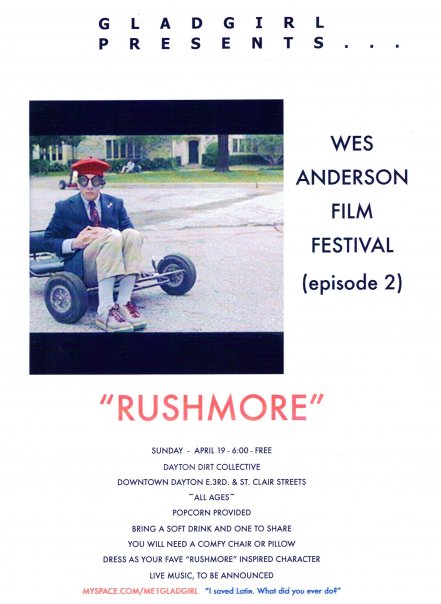
“Rushmore” at the Dayton (OH) Dirt Collective

Our pals at the Dayton Dirt Collective are hosting part 2 of their Wes Anderson Film Festival this Sunday, April 19 at 6:00 p.m. Eastern.

The show is free. Please bring a soft drink (and one to share!) and something to sit on! Popcorn will be provided. The DDC hopes to provide live music. Dress as your favorite Rushmore character (If someone takes pictures, I will post them here! I expect to see a Dart Boy!).

DDC is located at 144 East Third Street, Dayton, Ohio (Google Map).

daytondirtcollective

Wes on Jacques Tati

We knew from the Criterion Collection that Wes was involved in a Jacques Tati (Mon Oncle) retrospective at the Cinémathèque française in Paris, “Jacques Tati, deux temps, trois movements.” (2 April – 8 August).

The Independent (U.K.) reports that Wes wrote a short essay for the exhibition catalogue:

In a short essay for the catalogue to the Paris exhibition on Tati’s life and career, Anderson (The Darjeeling Limited; The Royal Tenenbaums) says that Tati, as actor and comedian, stands comparison with Charlie Chaplin and Buster Keaton. “He has a silhouette that you can make into a cartoon; just his walk is a great creation,” he says.

As for Jacques Tati’s importance as a film-maker, both Anderson and David Lynch (Twin Peaks; The Elephant Man) point to his unconventional and pioneering use of sound. This may seem surprising. There is hardly any dialogue in Tati movies. Much of his humour seems to be visual, based on elaborately devised gags developed from his early days as a stage comedian and mime artist. (Tati was also, as a young man, a talented professional rugby player, a second row forward for Racing Club de Paris in the French first division.)

Anderson says Tati’s elusive use of snatches of half-heard conversation and the repetition of strange or suggestive noises were decades ahead of their time. Lynch points out that a large part of the humour and oddly melancholy atmosphere of Monsieur Hulot or Mon Oncle are created by soundtracks that audiences scarcely notice. Jacques Tatischeff was born into a Franco-Russian family in Paris in 1907. His mother was of Dutch origin, something which, he claimed, shaped his meticulous approach to comedy. “It is almost impossible to make the Dutch laugh,” he once said.

The catalogue is available on amazon.fr. If you have additional information about this event, please contact edwardappleby @ yankeeracers.org.

Substance of Style, Part 4

The Substance of Style, Part 4

The Substance of Style, Part III

The next installment of Matt Zoller Seitz’s video essay at the Museum of the Moving Image has been posted. This one focuses on director Hal Ashby (Harold and Maude, Being There). Seitz concludes:

There’s nothing inherently wrong with Anderson’s selective adoration. But when you look at the totality of what Ashby accomplished—the social and political dimensions that all his films explored, the blunt honesty of their expression—Anderson’s work can’t help but come up short, just as the work of Anderson’s imitators is overshadowed by the genuine article.

Our pal Gerry Caravan responds:

Tell Matt Seitz he just made my list of things to do today. In all seriousness, I guess I can see Seitz’s point, but you can only conclude “Anderson’s work can’t help but come up short” when you demand of Anderson’s work the things it is quite pointedly refusing to do.

Part II.
Part I, “Introduction.”

The Substance of Style, Part II

Another video essay from Matt Zoller Seitz at the Museum of the Moving Image. This time, Martin Scorsese, Richard Lester, and Mike Nichols.

Here is Part I, “Introduction.”

Press notes and credits for Fantastic Mr. Fox

from Hollywood.blog (Netherlands):

These are said to be the press notes and credits for Fantastic Mr. Fox. I cannot absolutely confirm their authenticity at this point but have no reason to believe that they are are a fabrication.


Based on the beloved story by Roald Dahl, the film tells the tale of the noble, charming and fantastic Mr. Fox, who uses his wits and cunning to outfox three dimwitted farmers who tire of sharing their chickens with the crafty creature.

“Boggis and Bunce and Bean.  One short, one fat, one lean.  These horrible crooks, so different in looks, were nonetheless equally mean.”

Wes Anderson (The Life Aquatic with Steve Zissou, The Royal Tenenbaums, The Darjeeling Limited) directs the stop-motion animation of Roald Dahl’s much loved children’s book. Fantastic Mr. Fox is voiced by George Clooney, Meryl Streep, Jason Schwartzman, Bill Murray and Michael Gambon, and scheduled for release in the fall of 2009.

Continue reading “Press notes and credits for Fantastic Mr. Fox”