Substance of Style, Part 5

The last one, part 5!

This is the fifth in a five-part series of video essays analyzing the key influences on Wes Anderson’s style. Part 1 covers Bill Melendez, Orson Welles, and François Truffaut. Part 2 covers Martin Scorsese, Richard Lester, and Mike Nichols. Part 3 covers Hal Ashby. Part 4 covers J.D. Salinger.

Yankee Racers registration

New user registration on the Yankee Racers forum will require moderator activation until further notice.

Please e-mail edwardappleby @ yankeeracers.org from the registered e-mail address to expedite this process.

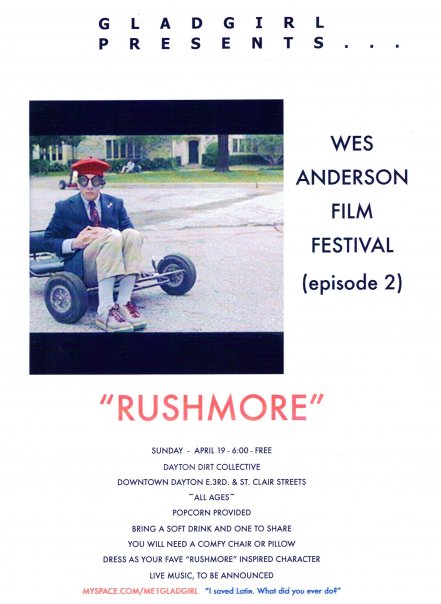
“Rushmore” at the Dayton (OH) Dirt Collective

Our pals at the Dayton Dirt Collective are hosting part 2 of their Wes Anderson Film Festival this Sunday, April 19 at 6:00 p.m. Eastern.

The show is free. Please bring a soft drink (and one to share!) and something to sit on! Popcorn will be provided. The DDC hopes to provide live music. Dress as your favorite Rushmore character (If someone takes pictures, I will post them here! I expect to see a Dart Boy!).

DDC is located at 144 East Third Street, Dayton, Ohio (Google Map).

daytondirtcollective

Wes on Jacques Tati

We knew from the Criterion Collection that Wes was involved in a Jacques Tati (Mon Oncle) retrospective at the Cinémathèque française in Paris, “Jacques Tati, deux temps, trois movements.” (2 April – 8 August).

The Independent (U.K.) reports that Wes wrote a short essay for the exhibition catalogue:

In a short essay for the catalogue to the Paris exhibition on Tati’s life and career, Anderson (The Darjeeling Limited; The Royal Tenenbaums) says that Tati, as actor and comedian, stands comparison with Charlie Chaplin and Buster Keaton. “He has a silhouette that you can make into a cartoon; just his walk is a great creation,” he says.

As for Jacques Tati’s importance as a film-maker, both Anderson and David Lynch (Twin Peaks; The Elephant Man) point to his unconventional and pioneering use of sound. This may seem surprising. There is hardly any dialogue in Tati movies. Much of his humour seems to be visual, based on elaborately devised gags developed from his early days as a stage comedian and mime artist. (Tati was also, as a young man, a talented professional rugby player, a second row forward for Racing Club de Paris in the French first division.)

Anderson says Tati’s elusive use of snatches of half-heard conversation and the repetition of strange or suggestive noises were decades ahead of their time. Lynch points out that a large part of the humour and oddly melancholy atmosphere of Monsieur Hulot or Mon Oncle are created by soundtracks that audiences scarcely notice. Jacques Tatischeff was born into a Franco-Russian family in Paris in 1907. His mother was of Dutch origin, something which, he claimed, shaped his meticulous approach to comedy. “It is almost impossible to make the Dutch laugh,” he once said.

The catalogue is available on amazon.fr. If you have additional information about this event, please contact edwardappleby @ yankeeracers.org.

Steve Zissou vs. the pirates

pirates

From the Captain’s Memos, recent pirate activity compared to The Life Aquatic:

I would like to put side by side a checklist of what has happened in the Indian Ocean the past day and what has happened in The Life Aquatic. Mind you there are some differences, but ultimately the same…

REAL LIFE

1. Pirates board American flagged ship and hold crew hostage.
2. Things are taken from the ship as plunder.
3. Americans on board attack pirates and re-take ship.
4. Pirates are thwarted from ship with a hostage.
5. Americans gather up a rescue plan to save hostage.

Well, up until this point things were the same. The main difference here is that this guy still has yet to be rescued. I would also like to point out also that he is in the middle of the ocean because his dumbass capters ran out of gas. He also tried to escape but that failed. So hopefully like Life Aquatic, an awesome shootout ensues and he gets rescued.

THE LIFE AQUATIC

1. Pirates board the Belafonte taking the crew hostage
2. Things are taken from the ship as plunder
3. Zissou attacks pirates and re-takes ship
4. Pirates are thwarted from ship with a hostage.
5. Zissou and crew gather up a rescue plan to save hostage.
6. Zissou and crew come to island where hostage is held.
7. Amazing shootout ensues and Zissou saves the hostage.

In defense of The Life Aquatic

Spurred on by Matt Zoller Seitz’s video essays “The Substance of Style,” Jamie Rich has written an eloquent defense of The Life Aquatic, the film in Wes’ oeuvre that has received perhaps the harshest criticism:

That said, The Life Aquatic with Steve Zissou always seems to be the most maligned of these core films. Invariably, when talking about the movies with others, there is almost a knee-jerk need to claim that it is not as good as its siblings. It’s a comment that is so predictable and automatic, it has become one I no longer trust, at least without some further qualification. More often than not, it’s a movie that its detractors have seen once and never revisited, and whether they realize it or not, their main problem is an inability to forgive it for not being either Rushmore or The Royal Tenenbaums–which, of course, is absurd and also misses how amorphous the auteur really is. When you think about it, though one can draw a connector between those other films, that Rushmore is about the singular experience of the lone outcast and Tenenbaums is the collective experience of a family of outcasts (and one that Max Fischer might not have necessarily thrived in), they are also quite different. For as much as is made out of Anderson’s signature style, the creator is not as singular as even his ardent fans make him out to be. Though his is a rarefied world, a kind of shared universe where any of these stories could exist side by side in terms of creating a larger whole, each movie is distinctly different. They may have variations on similar themes, the way that, say, Romeo & Juliet, Hamlet, and King Lear all mine relatable veins of love both romantic and familial, but they distinguish themselves as separate entities; in tone and setting, the Wes Anderson oeuvre is as vast as those three Shakespeare plays (read more).

Webicon contest winner

Le winner!

Best in Show (42% of the vote)

shagass


Honourable mention
(23% of the vote)

revolution

Bravo, Max! We will be in touch!

Remember to buy Derek Hill’s Charlie Kaufman and Hollywood’s Merry Band of Pranksters, Fabulists and Dreamers: An Excursion Into the American New Wave (available for purchase on Amazon.com).

Substance of Style, Part 4

The Substance of Style, Part 4

Wes-inspired micro-hotel

NPR recenty reported on The Jane micro-hotel (and several others) in New York:

If $89 a night is still too high for your hotel budget, you can have a remarkably different experience at The Jane in Greenwich Village. The 5-by-7 rooms, former digs for sailors, offer the same level of technology as the accommodations at the Pod – including flat-screen TVs and iPod docking stations.

But the atmosphere at The Jane, housed in a building more than a century old, is straight out of Jules Verne: old-fashioned bellhops, huge keys, a backward clock, moose heads on the wall – and long-term tenants, 60 of them, who pay less than $700 a month.

“I call it the hotel at the end of the world,” says Samuel Gaedke, who has lived at The Jane for four years. “If you want to disappear off the face of the Earth for a little while, it is a good place to come to.”

The Jane’s single hotel rooms are $75 a night.

Sean McPherson, one of the owners of the hotel, has said he drew inspiration for the decor from the films Darjeeling Limited and The Royal Tenenbaums. He calls the rooms micro-chic.

“They’re very small,” he says. “They’re the size of a train cabin.”

McPherson says the hotel harkens back to the New York of the 1980s: grittier, more exotic, more adventurous – “a place for travelers with more dash than cash,” he says.

2009 Adrienne Shelly Foundation Online Auction

Adrienne Shelly (Waitress) was a talented actor and filmmaker who was tragically murdered in 2006. The Adrienne Shelley Foundation was founded in her memory to support female filmmakers, actors, and writers.  They are currently auctioning off film festival passes, autographed memorabiia, lunch meetings with celebrities, and even walk-on film roles.